Council to Take Total Control of Charlton/Albany House Scheme
Report rules out involving housing association or private partner
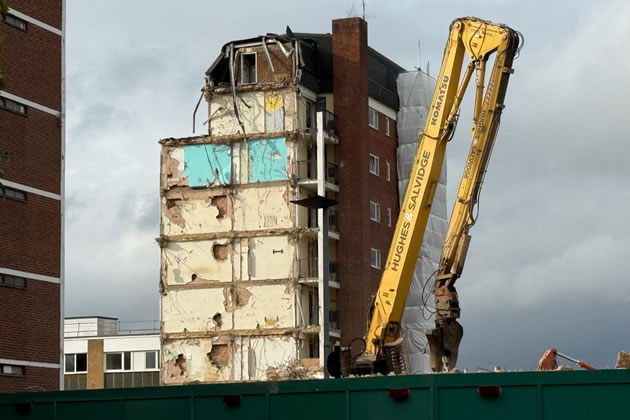
Demolition work at the site is expected to be complete this month . Picture: Brentford TV
March 12, 2026
The long-planned redevelopment of the Charlton House and Albany House estate in Brentford has entered a decisive new phase, with Hounslow Council set to consider a report this month that confirms how the scheme will finally be delivered.
The Cabinet paper, due to be presented to councillors at a meeting on 16 March, sets out the Council’s preferred approach, the updated design, the financial position and the timetable required to keep the project on track
The report recommends that the Council proceed with direct delivery of the scheme, meaning Hounslow will act as the developer, appoint the main contractor, and retain full control over design, tenure, sustainability standards and long-term management. This is the first time the Council has formally committed to this route, following earlier consideration of alternatives such as selling the site, transferring it to a housing association, or entering a joint venture with a private partner.
Although this approach does theoretically involved extra risk for the council, the project is funded through the Housing Revenue Account, which is ringfenced from the general budget therefore, even in the worse case, it is unlikely to have any impact on council tax rates.
The report sets out, for the first time, the final number of housing units in the revised scheme. Earlier plans proposed 211 units, but the redesign undertaken in 2025 reduced the height of the buildings to avoid High-Risk Building status under new safety legislation. This change, combined with cost-saving measures, resulted in a new total of 182 flats, all for council rent.
While previous reports explored multiple delivery models, this month’s paper concludes that only a council-led approach can guarantee 100% affordable housing, meet funding deadlines, and maintain the commitments made to residents during the 2021 ballot.
The report states that demolition, which began in May 2025, will be completed this month, clearing the site for construction..
The Council has secured significant grant funding from the Greater London Authority and the London Economic Regeneration Fund, but this funding will only be retained if construction begins by September 2026. This places considerable pressure on the Council to complete procurement and planning amendments on time.
The paper explains that the earlier Pre-Construction Services Agreement was terminated because the contractor’s 80% cost-certainty submission exceeded the available budget. This confirms that the original design could not be delivered within the Housing Revenue Account’s financial limits.
The report outlines the architectural and engineering changes made in 2025 to bring the project back within budget. These include simplified balconies, adjusted building footprints to avoid Thames Water infrastructure, and the creation of more than 2,500m² of new green space.
The Charlton House and Albany House regeneration has been one of Hounslow’s most closely watched projects. Residents voted overwhelmingly in favour of redevelopment in February 2021, with an 81% turnout and 87% support — one of the strongest mandates for estate regeneration in London. Planning permission followed in 2022, and the Council began acquiring properties and relocating residents through a Compulsory Purchase Order approved in 2023.
However, rising construction costs, new building safety regulations and the need to secure external funding forced the Council to revisit the design in 2025. The redesigned scheme now focuses on delivering high-quality, energy-efficient homes, with more than 30% of units providing three bedrooms or more to meet acute local need.
The report places the scheme firmly within the context of Hounslow’s worsening housing pressures. As of mid-2025, more than 4,400 households were on the waiting list for council homes, homelessness presentations had risen by 226% since 2018, and demand for larger family homes far exceeded supply. The Council argues that the CHAH redevelopment is essential to meeting its pledge to deliver 1,000 new council homes and to improving living conditions for residents.
If Cabinet approves the recommendations on 16 March, tender evaluation will conclude the following month with planning amendments to be determined by June when a main contractor will be appointed. This ensures that construction will begin by the September deadline which, if missed, would jeopardise millions in grant funding and could render the scheme financially unviable.
After years of planning, consultation, redesign and demolition, the Charlton House and Albany House regeneration is now poised to move into its delivery phase. For residents who backed the project five years ago, the coming months will determine whether the Council can fulfil its commitments.
Like Reading Articles Like This? Help Us Produce More This site remains committed to providing local community news and public interest journalism. Articles such as the one above are integral to what we do. We aim to feature as much as possible on local societies, charities based in the area, fundraising efforts by residents, community-based initiatives and even helping people find missing pets. We’ve always done that and won’t be changing, in fact we’d like to do more. However, the readership that these stories generates is often below that needed to cover the cost of producing them. Our financial resources are limited and the local media environment is intensely competitive so there is a constraint on what we can do. We are therefore asking our readers to consider offering financial support to these efforts. Any money given will help support community and public interest news and the expansion of our coverage in this area. A suggested monthly payment is £8 but we would be grateful for any amount for instance if you think this site offers the equivalent value of a subscription to a daily printed newspaper you may wish to consider £20 per month. If neither of these amounts is suitable for you then contact info@neighbournet.com and we can set up an alternative. All payments are made through a secure web site. One-off donations are also appreciated. Choose The Amount You Wish To Contribute. If you do support us in this way we’d be interested to hear what kind of articles you would like to see more of on the site – send your suggestions to the editor. For businesses we offer the chance to be a corporate sponsor of community content on the site. For £30 plus VAT per month you will be the designated sponsor of at least one article a month with your logo appearing if supplied. If there is a specific community group or initiative you’d like to support we can make sure your sponsorship is featured on related content for a one off payment of £50 plus VAT. All payments are made through a secure web site. |