Path Around Brentford Dock Confirmed as Public Right of Way
Council issues order to officially protect access to the riverside
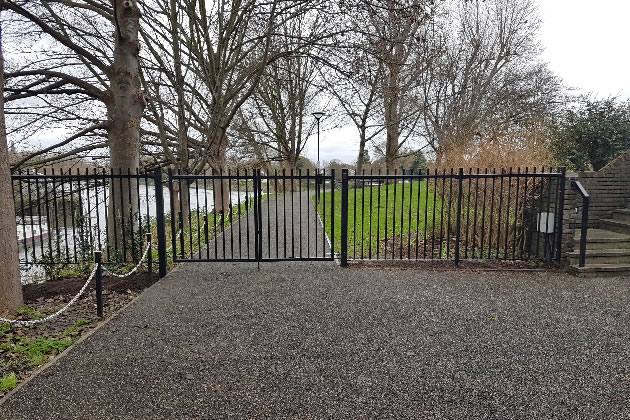
One of the gates that had blocked entrance to Brentford Dock. Picture: Brentford Voice
September 1, 2026
Hounslow Council has taken a decisive step in the long-running dispute over public access at Brentford Dock by issuing a legal Order to add the estate’s riverside perimeter path to the borough’s Definitive Map of Public Rights of Way.
The decision, signed on 1 September 2026 by Peter O’Brien, Executive Director of Placemaking and Growth, follows nearly two years of investigation into historic use of the route, the estate’s development history, and the evidence submitted by campaigners seeking formal recognition of the path.
The Order covers the circular waterfront route around the Brentford Dock peninsula, a path used by local residents, walkers and visitors since the late 1970s. The council’s report concludes that there is sufficient evidence to show that the public has used the route “as of right” for decades, “without force, secrecy or permission”, and that this long, uninterrupted use meets the legal threshold for a presumption of dedication under the Highways Act 1980.
More than forty witness statements were submitted by Brentford Walks, many describing weekly or daily use stretching back over twenty, thirty or even forty years. The council found that this evidence was consistent, credible and substantial enough to justify adding the path to the Definitive Map.
The council did not accept the case for the smaller internal routes linking the perimeter path to Augustus Close and Justin Close, concluding that the evidence for those sections was insufficient. However, the main circular route was judged to meet the statutory tests. The Order is now subject to public consultation until 31 October, after which it may be confirmed by the council or referred to the Secretary of State if objections are received.
This latest development comes against the backdrop of a four-year dispute over access at Brentford Dock. In 2020, Brentford Dock Ltd (BDL) installed gates and security patrols to restrict public entry, arguing that the land was private and that anti-social behaviour had increased. Campaigners countered that the riverside had been freely accessible for decades and that the restrictions were heavy-handed and legally questionable. The situation shifted dramatically earlier this year when council lawyers located a 1991 Public Open Space Agreement in archives in Oxford. The agreement, signed when the former Estmanco company purchased the estate, requires the Dock to allow public access to a designated riverside area “at all reasonable times”. Brentford Dock Ltd accepted the agreement’s validity and reopened a gate on Augustus Close on 1 February, but imposed new rules limiting access to 9am–4pm and prohibiting dogs. Campaigners argued that these conditions contradicted the wording of the agreement, which they say requires access well beyond mid-afternoon, especially in summer.
Residents also reported confusion about whether the restrictions applied to them as well as the wider public, with one person saying they were unable to enter the area at 8pm the previous evening. Brentford Dock Ltd said it had acted swiftly to comply with the agreement but warned that safety, risk management and the practicalities of allowing public access through a private residential estate remained unresolved. The company said it would increase security patrols and consider additional measures such as CCTV.
The council’s decision document sets out a detailed legal analysis of the history of the estate, the original 1970s development plans, the presence and relevance of signage over the years, and the question of whether the landowner had clearly demonstrated an intention not to dedicate the path as a public right of way. Officers concluded that signage was inconsistent, often unclear, and in some cases not visible from the perimeter path itself. They also noted that no statutory notice had ever been served on the council to declare that the landowner did not intend to dedicate the route as a public highway. Taken together, the evidence pointed towards long-standing public use and insufficient action by the landowner to prevent public rights from accruing.
The Order marks a significant moment in a dispute that has involved residents, walkers, heritage groups and the Dock’s management for several years. If confirmed, it would secure permanent public access to the waterfront route and bring clarity to an issue that has been fraught with uncertainty.
Stephen Clark of Brentford Walks said, ‘We would especially like to thank the many people who gave evidence statements outlining their experience of walking these paths, in total, over a period 40/50 years. We couldn’t have achieved this without them. This Public Right of Way will add to the many things that make Brentford a special place to live, and will allow for residents to enjoy valuable open space in a dense and often unhealthy urban environment. It is to hoped that BDL will not oppose confirmation of the order and will remove any gates, signage and other impediments to the public enjoyment of the space.’
BDL has been asked for comment.
Like Reading Articles Like This? Help Us Produce More This site remains committed to providing local community news and public interest journalism. Articles such as the one above are integral to what we do. We aim to feature as much as possible on local societies, charities based in the area, fundraising efforts by residents, community-based initiatives and even helping people find missing pets. We’ve always done that and won’t be changing, in fact we’d like to do more. However, the readership that these stories generates is often below that needed to cover the cost of producing them. Our financial resources are limited and the local media environment is intensely competitive so there is a constraint on what we can do. We are therefore asking our readers to consider offering financial support to these efforts. Any money given will help support community and public interest news and the expansion of our coverage in this area. A suggested monthly payment is £8 but we would be grateful for any amount for instance if you think this site offers the equivalent value of a subscription to a daily printed newspaper you may wish to consider £20 per month. If neither of these amounts is suitable for you then contact info@neighbournet.com and we can set up an alternative. All payments are made through a secure web site. One-off donations are also appreciated. Choose The Amount You Wish To Contribute. If you do support us in this way we’d be interested to hear what kind of articles you would like to see more of on the site – send your suggestions to the editor. For businesses we offer the chance to be a corporate sponsor of community content on the site. For £30 plus VAT per month you will be the designated sponsor of at least one article a month with your logo appearing if supplied. If there is a specific community group or initiative you’d like to support we can make sure your sponsorship is featured on related content for a one off payment of £50 plus VAT. All payments are made through a secure web site. |