Public Access Restored at Brentford Dock
Campaigners for non-resident use unhappy with new restrictions
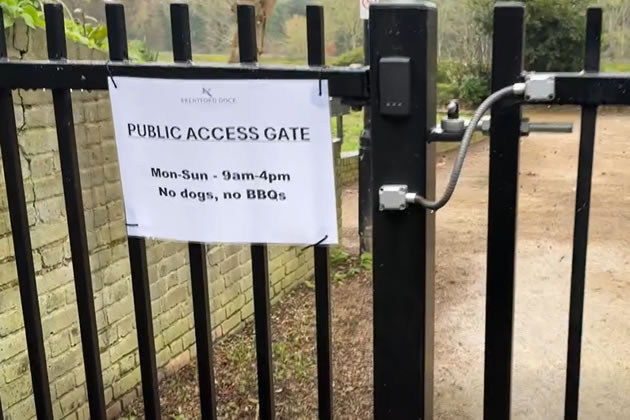
New signs have appears at the gates given access to the waterside. Picture: Brentford TV
February 6, 2026
Public access to part of the riverside at Brentford Dock was reinstated on Sunday (1 February) after Hounslow Council informed Brentford Dock Limited (BDL) that a long-forgotten legal agreement from 1991 requires the estate to allow public use of designated pathways. The move marks a major development in a dispute that has lasted over four years.
In a message to residents on Friday (30 January), BDL confirmed that council lawyers had located the 1991 agreement — signed when the former Estmanco company purchased the estate — in archives in Oxford. Neither the current council leadership nor the Dock’s board had been aware of the document until late last year. BDL’s legal team has since accepted that the agreement is authentic and binding.
Under its terms, the public must be allowed access to the “blue-hatched” riverside area at “all reasonable times”. To comply, BDL opened a gate on Augustus Close on Sunday morning, providing a route for non-residents to enter the estate and reach the riverside path.
The reopening follows years of tension between residents, campaigners and the Dock’s management. In 2020, BDL installed gates and security patrols to restrict public access, arguing that the land was private and that anti-social behaviour and littering had increased. Opponents — including local walkers, heritage groups and residents of neighbouring streets — argued that the riverside had been used freely for decades and that the Dock’s actions were heavy-handed and legally questionable.
Campaigners, including Stephen Clark of Brentford Walks, submitted a Definitive Map Modification Order (DMMO) application to Hounslow Council seeking to have the estate’s pathways formally recognised as public rights of way. That application remains under consideration.
The discovery of the 1991 agreement has now shifted the legal landscape. While it might not automatically establish full public rights of way, it does oblige BDL to permit access to specific areas.
Although the gate was opened as promised, campaigners say BDL has imposed new rules that contradict the agreement. Signs displayed on Sunday stated that access is limited to 9am–4pm and that dogs are not permitted.
Opponents argue that these conditions breach the 1991 wording, which states that the public must have access “at all reasonable times”. With daylight extending well into the evening in summer, they say a 4pm cut-off is neither reasonable nor enforceable. Residents also questioned whether the rules apply equally to Dock residents and visitors, or only to the wider public.
One local reported being unable to access the area at 8pm the previous evening, suggesting the restrictions may apply to residents as well.
In its message to residents, BDL said it had acted swiftly to meet its legal obligations but warned that the matter is far from resolved. The company said further negotiations with the council are ongoing regarding safety, risk management and the practicalities of allowing public access through a private residential estate.
BDL said it would increase security patrols to protect residents’ “quiet and peaceful environment” and is considering additional measures such as CCTV. The board acknowledged that the news may be “unwelcome” to some residents but stressed that non-compliance with the 1991 agreement was not an option.
Stephen Clark of Brentford Walks welcomed the partial reopening but said the access route remains “woefully inadequate and convoluted”, with no provision for disabled users who can only gain access via steep steps. He urged the council to progress the DMMO application and formally recognise the estate’s pathways as public rights of way.
“The Dock has finally accepted that it signed an agreement 34 years ago,” he said. “But this is not sorted out yet.”
BDL has said it will hold meetings with residents in February to discuss the implications of the agreement and the ongoing negotiations with the council. Hounslow Council has not yet commented publicly on the new restrictions or the next stage of the legal process.
Like Reading Articles Like This? Help Us Produce More This site remains committed to providing local community news and public interest journalism. Articles such as the one above are integral to what we do. We aim to feature as much as possible on local societies, charities based in the area, fundraising efforts by residents, community-based initiatives and even helping people find missing pets. We’ve always done that and won’t be changing, in fact we’d like to do more. However, the readership that these stories generates is often below that needed to cover the cost of producing them. Our financial resources are limited and the local media environment is intensely competitive so there is a constraint on what we can do. We are therefore asking our readers to consider offering financial support to these efforts. Any money given will help support community and public interest news and the expansion of our coverage in this area. A suggested monthly payment is £8 but we would be grateful for any amount for instance if you think this site offers the equivalent value of a subscription to a daily printed newspaper you may wish to consider £20 per month. If neither of these amounts is suitable for you then contact info@neighbournet.com and we can set up an alternative. All payments are made through a secure web site. One-off donations are also appreciated. Choose The Amount You Wish To Contribute. If you do support us in this way we’d be interested to hear what kind of articles you would like to see more of on the site – send your suggestions to the editor. For businesses we offer the chance to be a corporate sponsor of community content on the site. For £30 plus VAT per month you will be the designated sponsor of at least one article a month with your logo appearing if supplied. If there is a specific community group or initiative you’d like to support we can make sure your sponsorship is featured on related content for a one off payment of £50 plus VAT. All payments are made through a secure web site. |