Chiswick Roundabout Ad Towers Could Be Replaced with Fake Trees
Proposal for structures at to have art nouveau design
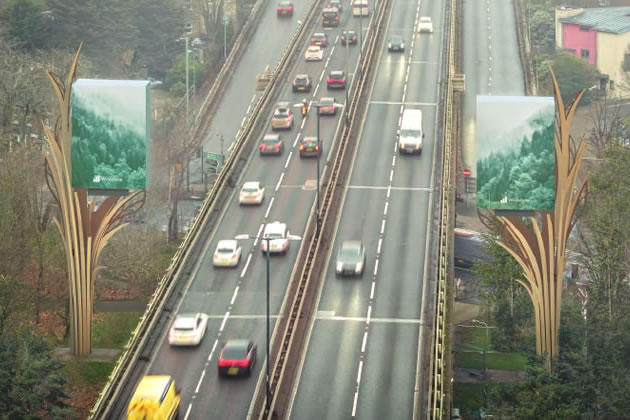
A visualisation of the planned towers from planning documentation
July 1, 2026
A proposal is being made to replace the pair of digital advertising towers by Chiswick Roundabout with something rather unusual: structures designed to look like trees.
The application by outdoor advertising company Wildstone, asks the London Borough of Hounslow for permission to replace two existing billboard structures. The screens themselves — large digital displays visible to drivers on the flyover — have been there for some time but what is changing is what holds them up.
The existing structures are conventional advertising frames sit on the central island of the Chiswick Roundabout, beneath the flyover itself, pointing outwards towards the M4 carriageways. They work, in the sense that drivers can see them clearly in both directions. But few people would describe them as an asset to the area.
The proposed replacements, designed by London architects Tate+Co, would consist of a central steel mast surrounded by curved timber fins that spiral upwards and outwards, evoking the form of a tree trunk branching into a canopy. The effect is of two giant plant-like forms rising from the roundabout, cradling the advertising screens between them.
The design draws on art nouveau — the style best known for its use of organic, flowing forms borrowed from nature — as well as contemporary timber engineering. The architects looked at precedents including mass timber frame buildings and ornamental metalwork, and the early sketches in the application show them working through numerous organic configurations before arriving at the current form.
The screens themselves would sit within the timber structure, facing the M4 carriageways as they do now. Screen sizes would be slightly adjusted from the existing arrangement, but the overall height of the structures would actually be marginally lower than what is currently in place. The footprint stays identical: the new structures would sit on the same existing concrete bases and reuse the same underground foundations, avoiding any need for new groundworks on the flyover.
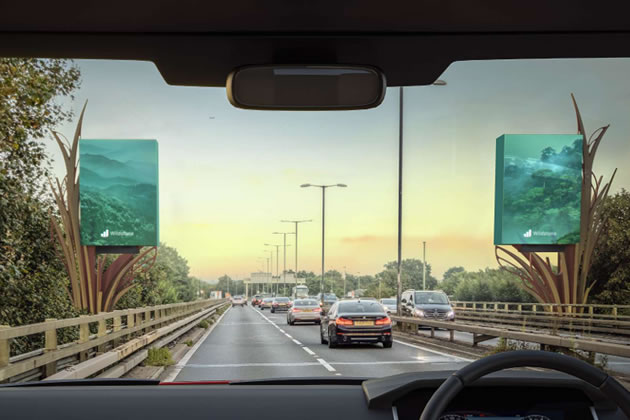
A visualisation of the view of the ad towers from a vehicle on the flyover
The timber elements are proposed to be coated in a combined fire-resistant and weatherproofing treatment designed to give a minimum lifespan of 30 years outdoors without significant degradation.
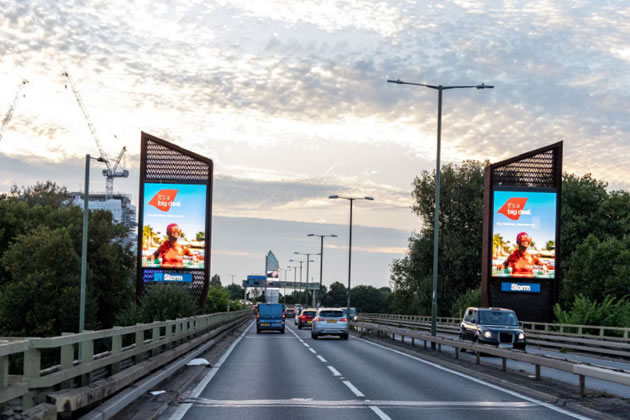
The towers by Chiswick Roundabout as they are currently
The steel frame underneath would be finished in what the designers call an Aged Bronze Stipple — a treatment that produces a warm, browned finish similar to weathered metal, giving the structure visual warmth while protecting it from corrosion. This was the same finish used on metalwork recently completed at the Queen Elizabeth II Garden in Regent's Park, which the architects also worked on.
The screens themselves would use LED technology, which uses less energy than older display systems. Brightness would be controlled automatically by sensors, reducing to 300 candelas per square metre at night and increasing to 600 during daylight and dawn conditions — levels set by the Institute of Lighting Professionals. The application includes analysis showing that light from the screens would not fall on any nearby residential properties, which are sufficiently distant that nuisance is not considered a realistic concern.
The timber fins are specifically positioned to partially screen the displays from certain angles, ensuring they are most visible to drivers on the carriageway rather than creating a blaze of light in all directions.
Like Reading Articles Like This? Help Us Produce More This site remains committed to providing local community news and public interest journalism. Articles such as the one above are integral to what we do. We aim to feature as much as possible on local societies, charities based in the area, fundraising efforts by residents, community-based initiatives and even helping people find missing pets. We’ve always done that and won’t be changing, in fact we’d like to do more. However, the readership that these stories generates is often below that needed to cover the cost of producing them. Our financial resources are limited and the local media environment is intensely competitive so there is a constraint on what we can do. We are therefore asking our readers to consider offering financial support to these efforts. Any money given will help support community and public interest news and the expansion of our coverage in this area. A suggested monthly payment is £8 but we would be grateful for any amount for instance if you think this site offers the equivalent value of a subscription to a daily printed newspaper you may wish to consider £20 per month. If neither of these amounts is suitable for you then contact info@neighbournet.com and we can set up an alternative. All payments are made through a secure web site. One-off donations are also appreciated. Choose The Amount You Wish To Contribute. If you do support us in this way we’d be interested to hear what kind of articles you would like to see more of on the site – send your suggestions to the editor. For businesses we offer the chance to be a corporate sponsor of community content on the site. For £30 plus VAT per month you will be the designated sponsor of at least one article a month with your logo appearing if supplied. If there is a specific community group or initiative you’d like to support we can make sure your sponsorship is featured on related content for a one off payment of £50 plus VAT. All payments are made through a secure web site. |